

Ordering Research Peptides Online: A Laboratory Purchasing Workflow

Updated: Oct 11

This guide focuses on the laboratory purchasing workflow: document your requirements, review supplier information, place an order and retain receiving records. For Premier Aminos-specific eligibility, checkout, shipping and order-support information, start with the links below. Products are for in vitro laboratory research only.
Research Resources — start with the catalog, policies and related reading.
Ordering from Premier Aminos
Review the research affiliation and age requirements in our Terms & Conditions. Browse the catalog, select the available size and pack option, enter the quantity, and review shipping and payment details at checkout. Sign in when prompted to view pricing. Retain your order confirmation and tracking information. For an existing order, include your order number when contacting support.
Terms & Conditions — review eligibility and purchase requirements.
Payment & Shipping — check processing and delivery information.
Refunds & Returns — review the process for damaged, missing or incorrect orders.
Table of Contents
Quick Summary
Core Insight | Explanation |
1. Define Your Peptide Specifications | Clearly outline the peptide characteristics necessary for your research to avoid ordering errors and ensure relevance to your study. |
2. Assess Vendor Quality and Transparency | Choose peptide suppliers who provide detailed certificates of analysis and maintain robust quality control practices to ensure product reliability. |
3. Verify Purity and Testing Documentation | Carefully evaluate COAs, testing methods, and impurity profiles to confirm that peptides meet research standards before use. |
4. Secure Your Ordering Process | Implement secure payment methods and verify supplier compliance with institutional and regulatory requirements to protect your research. |
5. Authenticate Delivery Upon Arrival | Inspect the package and validate the peptide product against order documents to ensure you received the correct and high-quality material. |
Step 1: Identify research needs and peptide specifications
Before purchasing peptides online, you need to clearly define what your research requires. This means understanding your experimental goals and translating them into specific peptide characteristics. Taking time here prevents costly mistakes later and ensures you order exactly what you need.
Start by documenting your research objectives. Ask yourself what role peptides play in your study. Are you investigating signal pathways, testing biomarker detection, or developing therapeutic compounds? Your answer determines which peptide sequences and properties matter most.
Next, define the critical specifications that directly impact your results:
Peptide sequence: Which amino acid sequence matches your research target?
Purity level: Does your application require ≥99% purity or will a lower threshold work?
Stability requirements: How must the peptide be stored and for how long?
Quantity needed: Are you running preliminary tests or scaling up experiments?
Delivery timeline: When do you need the peptide available in your lab?
Understanding peptide characteristics such as pharmacokinetics and immunogenicity risk helps you define specifications that directly address your research goals. Consider what detection methods you’ll use—if you’re relying on mass spectrometry, validated peptide mass spectral data can help confirm your specification choices.
Consult existing literature and any institutional protocols your lab follows. This ensures consistency with established methods and helps you avoid reinventing specification standards. When selecting a supplier, you can reference these detailed specifications to request matching documentation and certificates of analysis.
Clear specifications prevent ordering errors and ensure your peptide investment directly supports your research objectives.
You might also reference our guide on how to choose peptides for research to align your specifications with broader selection criteria.
Here’s a quick summary of peptide specification criteria and their research impact:
Specification Aspect | Why It Matters | Typical Research Use |
Sequence Accuracy | Ensures biological relevance | Targeting signal pathways |
Purity Level | Prevents data contamination | Biomarker testing |
Stability | Maintains peptide integrity | Long-term storage |
Quantity | Avoids shortages or waste | Preliminary or large-scale studies |
Delivery Time | Aligns with project deadlines | Urgent experiments |
Pro tip: Create a specification checklist document now that lists your required sequence, purity percentage, volume, and delivery date—this becomes your purchasing reference when evaluating suppliers and ensures you compare apples to apples across vendors.
Step 2: Evaluate and verify trusted peptide vendors
Not all peptide suppliers are created equal. Your vendor choice directly affects the quality, reliability, and credibility of your research results. This step teaches you how to assess vendors systematically so you can confidently purchase from suppliers who meet rigorous research standards.

Start by identifying vendors with transparent quality documentation. Request their certificates of analysis (COAs) for any peptide you’re considering. A legitimate supplier provides detailed COAs that specify purity percentages, batch numbers, and testing dates. These documents prove the peptide matches what you ordered.
Evaluate the vendor’s quality control practices. Look for suppliers who conduct third-party testing through independent laboratories. This eliminates conflicts of interest and provides unbiased verification of product specifications. Check whether the vendor publishes their testing methodology and can explain how they validate product authenticity.
Ask the vendor to clarify its stated role, product specifications and purchasing requirements. Do not infer manufacturing practices, regulatory approval or experimental suitability from the phrase “research grade” alone. Your institution should determine which requirements apply to its procurement and planned work.
Check these vendor credentials specifically:
Purity guarantees: Do they offer ≥99% purity assurance with documentation?
Testing transparency: Can they explain their COA data and testing procedures?
Shipping reliability: Do they provide fast, secure delivery to your location?
Customer support: Will they answer technical questions about their products?
Track record: Can they provide references from other research institutions?
Contact the vendor directly with your detailed specifications from Step 1. A trustworthy supplier responds promptly and professionally. They ask clarifying questions about your research needs and recommend appropriate products based on your requirements, not just their inventory.
Vendors willing to provide detailed documentation and answer technical questions demonstrate the transparency your research deserves.
Pro tip: Request COAs before purchasing and compare testing dates across multiple vendors—the most recent test results indicate fresher inventory and more current quality assurance practices that benefit your research timeline.
Step 3: Review purity documentation and lab test results
Purity documentation makes or breaks your peptide purchase decision. Lab test results provide the scientific evidence that your peptide meets the specifications you defined in Step 1. This step walks you through reading and evaluating these documents like a seasoned researcher.
Start by examining the Certificate of Analysis (COA). A complete COA includes the peptide name, sequence, batch number, testing date, and purity percentage. Look for the specific purity value—research-grade peptides typically show ≥99% purity. Verify that the batch number on the COA matches the label on the peptide container you receive.
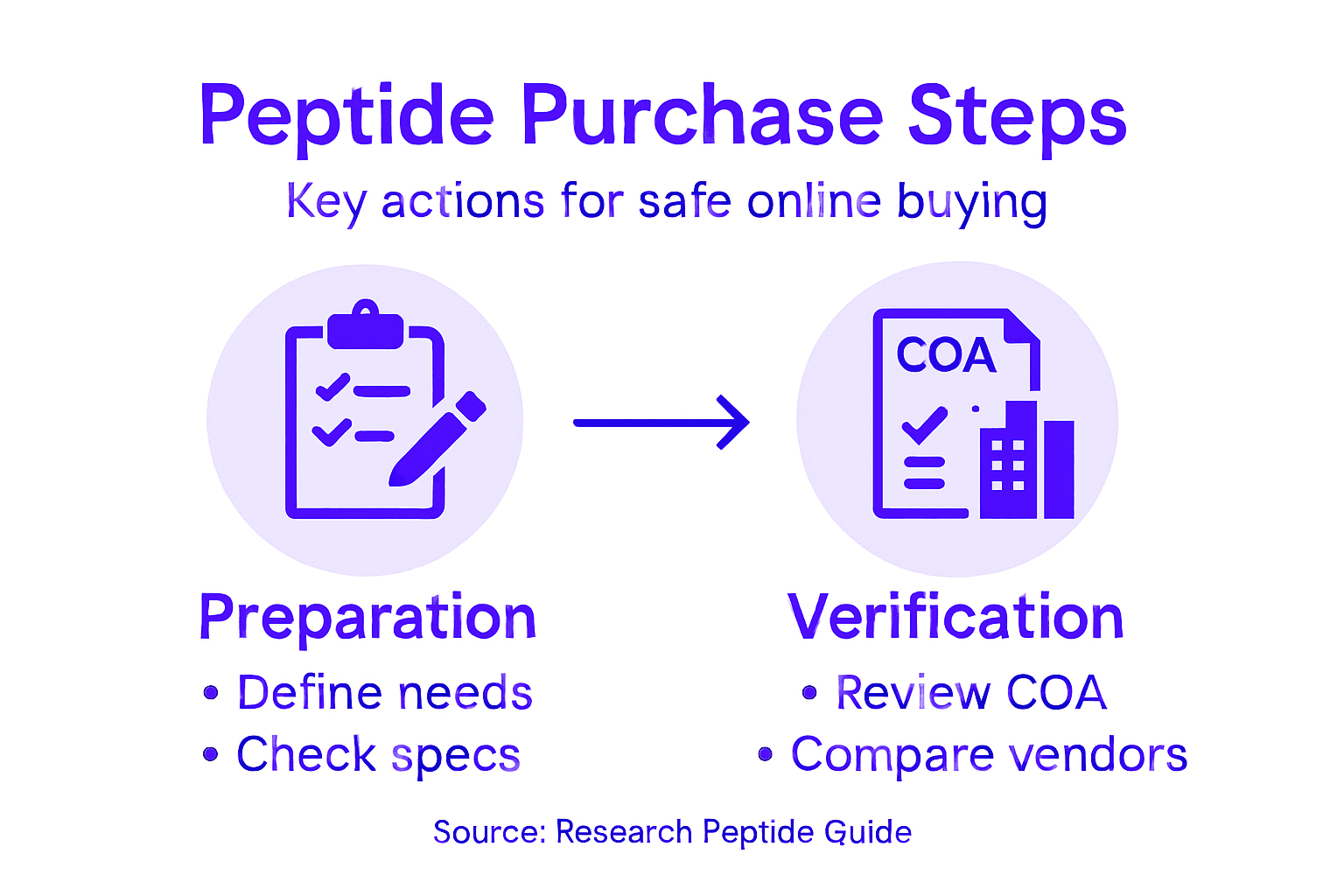
Understand the testing methodology used. Different analytical techniques provide different levels of detail about your peptide. Request information about which methods the supplier used to determine purity. Common methods include high-performance liquid chromatography (HPLC) and mass spectrometry. Understanding these techniques helps you evaluate whether the testing is appropriate for your research.
Review the validated analytical methods and acceptance criteria that establish industry standards for peptide characterization. These frameworks ensure purity measurements follow established protocols rather than proprietary or inconsistent approaches.
Check for metrological traceability in the test results. SI-traceable purity measurement methods ensure your purity values are scientifically reliable and comparable across different testing labs and suppliers. Look for references to NIST standards or equivalent traceability statements in the documentation.
Compare COAs from multiple batches if you plan repeat purchases. Consistency across batches indicates stable manufacturing processes. Variations in purity from batch to batch may signal quality control issues worth investigating.
Evaluate these specific COA elements:
Purity percentage: Is it ≥99% as required for your research?
Testing date: Is it recent enough for your experimental timeline?
Methodology: Can you verify the testing technique is appropriate?
Batch consistency: Do multiple batches show similar results?
Impurity profile: Are specific impurities identified and quantified?
Don’t hesitate to contact the supplier with questions about their COA data. Professional vendors can explain testing procedures, discuss impurity profiles, and clarify any discrepancies you notice.
A detailed, transparent COA with traceable testing methods indicates a supplier committed to research integrity.
Pro tip: Create a simple spreadsheet tracking COA data from your purchases—recording purity percentages, testing dates, and batch numbers helps you identify trends and ensures consistency across your research experiments.
Step 4: Complete secure ordering and ensure regulatory compliance
Before placing an order, review your institution’s procurement requirements, the supplier’s terms and the checkout details. These checks help identify missing information; they do not independently establish regulatory compliance.
Before ordering, obtain any purchasing or research approvals required by your institution. Premier Aminos products are restricted to in vitro laboratory research and are not intended for human or animal use.
Direct project-specific questions about applicable requirements to your institution’s responsible team. A supplier’s familiarity with regulatory terminology is not evidence of approval or a verified manufacturing process.
Read the supplier’s published privacy and purchasing policies. Ask about unclear business or product details before checkout, and provide only the information needed for the order and your institution’s purchasing process.
Secure your ordering process by taking these steps:
Use secure payment methods that protect financial information
Verify the supplier uses encrypted website connections (look for “https” in the URL)
Request a purchase order system if your institution requires formal documentation
Keep records of all communications, invoices, and shipping documentation
Obtain written confirmation of purity guarantees and delivery timelines
Provide complete and accurate ordering information. Include your institution name, laboratory address, principal investigator name, and any required compliance documentation. This information ensures your shipment reaches the correct location and can be properly tracked.
Review the supplier’s terms regarding data security and confidentiality. Your research institution likely has specific policies about vendor relationships. Confirm that the supplier respects these requirements before finalizing your order.
A secure, compliant ordering process protects your research data and ensures institutional accountability throughout your peptide purchase.
Pro tip: Request a dedicated account with your supplier once you establish a working relationship—this streamlines future orders, maintains consistent pricing, and creates a documented procurement history that satisfies institutional audit requirements.
Step 5: Validate delivery and authenticate peptide products
Your peptide has arrived. Before opening the package and beginning research, you need to validate the delivery and authenticate the product. This critical step confirms you received exactly what you ordered and protects the integrity of your experimental data.
Start by inspecting the physical package immediately upon receipt. Check for signs of damage, tampering, or exposure to extreme temperatures. Peptides are sensitive to heat and moisture, so examine the packaging materials and any protective insulation. If the package appears compromised, contact the supplier before opening it.
Verify the delivery documentation matches your order. Compare the packing slip against your original purchase order. Check that the batch number, peptide name, sequence, and quantity all match what you ordered in Step 4. Discrepancies here warrant immediate clarification with the supplier.
Authenticate the peptide product using the supplied documentation. Compare the COA provided with your shipment against any previous COAs you received during evaluation. The batch numbers must match. Verify that quality control standards for impurity profiling and sequence confirmation are clearly documented and align with regulatory expectations.
Confirm identity and purity using reference standards when possible. USP official standards and reference materials for peptides facilitate authentication by providing documentation of purity, identity, and control of related impurities. Reference these standards against your delivered product’s specifications.
Perform these authentication checks:
Match batch number on package label to COA documentation
Verify peptide sequence matches your specification sheet
Confirm purity percentage meets your research requirements
Check storage instructions and expiration dates
Inspect container integrity and labeling clarity
Review testing dates to ensure freshness
Store the peptide according to the supplier’s instructions immediately after authentication. Temperature, light exposure, and humidity all affect peptide stability. Proper storage preserves the purity documented in the COA and ensures your experimental results remain valid.
Document your receipt and authentication in your lab records. Record the batch number, receipt date, storage location, and any observations about product condition. This documentation supports research reproducibility and institutional compliance.
Compare key peptide authentication checks at delivery:
Authentication Step | What to Look For | Reason for Verification |
Batch Number Match | Matches COA and label | Confirms order accuracy |
Sequence Confirmation | Matches specification sheet | Ensures correct peptide in use |
Purity Verification | ≥99% as required | Guarantees research-grade materials |
Storage Instruction Review | Follows recommended guidelines | Prevents sample degradation |
Thorough authentication upon delivery confirms your peptide investment matches quality standards and protects your experimental integrity.
Pro tip: Create a simple authentication checklist you complete for every peptide delivery—photograph the package, batch label, and COA together as timestamped evidence, then file these records with your experimental data to satisfy audit requirements and enable future reference.
Elevate Your Research with Premier Aminos’ Purity-Guaranteed Peptides
Navigating the complexities of purchasing research peptides online can be overwhelming, especially when you require precise specifications and reliable documentation like Certificates of Analysis (COAs). If you value transparency, batch consistency, and ≥99% purity for your research-grade peptides, Premier Aminos is here to simplify your procurement process. From detailed product specifications to fast U.S. shipping, our collection empowers your lab with confidence and compliance.
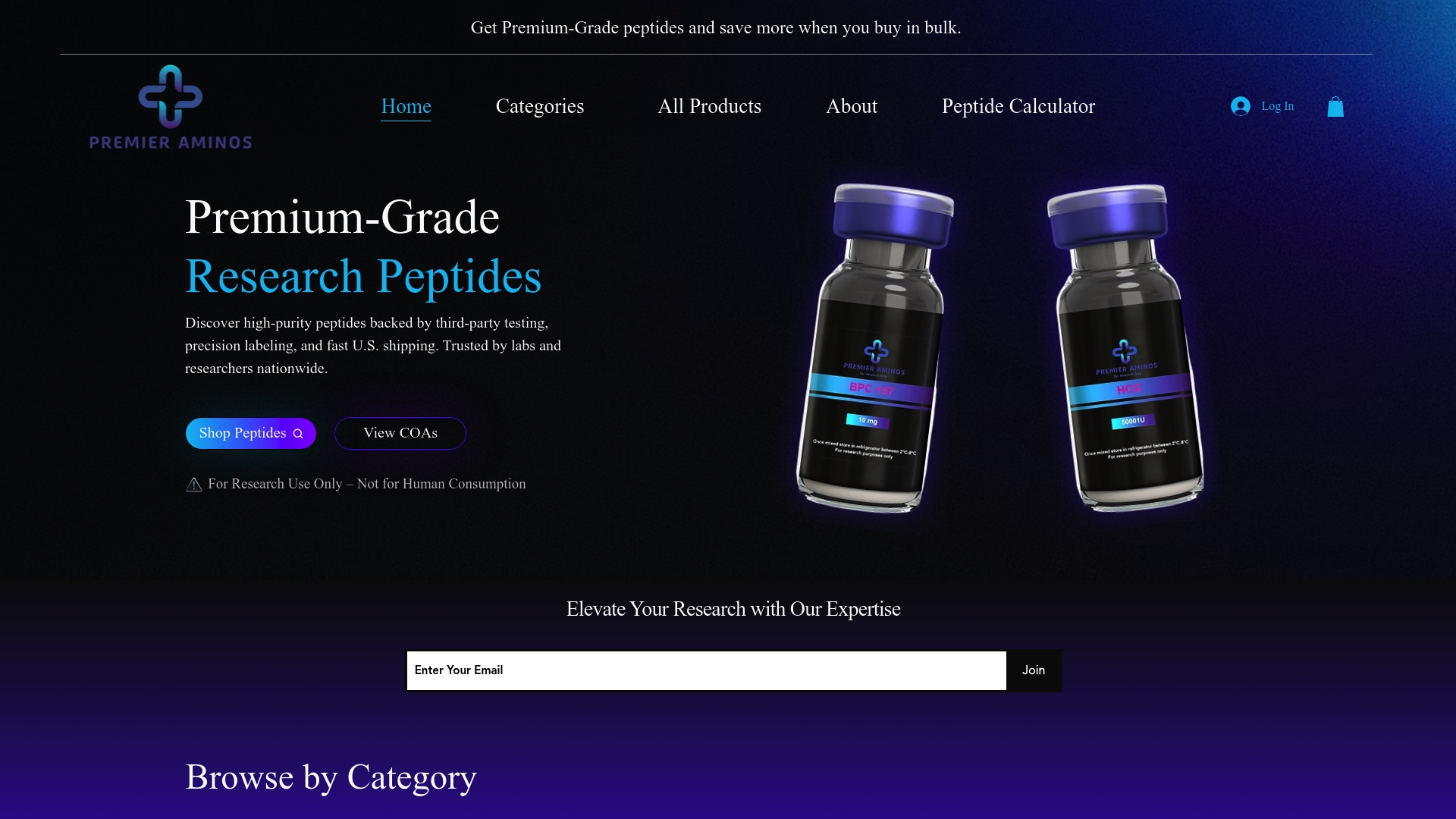
Explore our curated catalog featuring a wide array of scientifically validated peptides, including popular options found in our Peptides | Premier Aminos category and specialized selections such as Research Peptides | Premier Aminos. Each product comes backed by third-party lab testing and complete documentation, ensuring your order matches your exact research needs. Visit Premier Aminos now to experience quality and reliability that supports your scientific breakthroughs and streamlines your procurement workflow.
Frequently Asked Questions
What should I consider when identifying my research peptide specifications?
Before purchasing research peptides, clearly define your experimental goals and necessary peptide characteristics. Document your research objectives and ensure you consider aspects like peptide sequence, purity level, stability requirements, and delivery timeline.
How do I evaluate the credibility of peptide vendors?
To evaluate peptide vendors, request their Certificates of Analysis (COAs) and verify their quality control practices. Look for third-party testing and ask about their compliance with industry standards to ensure you receive reliable and authentic products.
What elements should I review in the purity documentation of peptides?
When reviewing purity documentation, check the Certificate of Analysis for key elements such as the peptide name, batch number, testing date, and purity percentage. Ensure that the purity meets your research requirements, typically ≥99% for research-grade peptides.
How can I ensure my peptide order is compliant with institutional regulations?
Verify your institution’s specific requirements for research approvals before placing your order. Ensure that the supplier follows applicable regulations related to peptide procurement and documentation, protecting your research integrity throughout the process.
What steps should I take upon receiving my peptide delivery?
Inspect the package for any damage or tampering before opening it. Compare the delivery documentation to your original order, and authenticate the peptide product using the COA to confirm you received the correct item in good condition.
Why is it important to maintain proper storage of peptides after delivery?
Maintaining proper storage of peptides immediately upon delivery is crucial to preserving their stability and integrity. Follow the supplier’s storage instructions carefully to ensure that the peptides remain effective for your research experiments.
Recommended
Related guides and sources
Research Resources — browse the connected guides and support pages.
IUPAC peptide terminology — reference for the meaning of peptide.
Peptide handling research — research recommendations for mass spectrometry-based assays; handling depends on the particular peptide and experimental conditions.


Comments