

Role of Peptides in Research—Impact on Experimental Success

Updated: Sep 5

Navigating complex biological questions often starts with reliable molecular tools. As research scientists at prominent academic and biotech institutions worldwide, precision and reproducibility define every experimental advance. Short amino acid chains known as peptides deliver extraordinary versatility, supporting investigations into intricate molecular interactions. This article clarifies how laboratory peptides unlock opportunities for detailed structural study, experimental manipulation, and high-impact research, highlighting essential purity standards for consistent, actionable results.
Table of Contents
Key Takeaways
Point | Details |
Peptide Versatility | Peptides serve as molecular building blocks in research, enabling precise investigation of biological interactions. |
Research Applications | Various peptide categories, such as therapeutic and diagnostic peptides, offer unique opportunities for addressing complex scientific challenges. |
Quality Control Importance | Ensuring peptide purity and structural integrity through rigorous quality control is essential for reproducibility in experiments. |
Regulatory Compliance | Adhering to safety protocols and regulatory standards is critical for ethical research practices and protecting researchers’ safety. |
Defining Peptides and Their Laboratory Functions
Peptides represent short amino acid chains strategically linked through amide bonds, serving as fundamental molecular building blocks in scientific research. These microscopic protein components possess extraordinary versatility, enabling researchers to investigate complex biological interactions with remarkable precision. Laboratory peptide structures demonstrate remarkable potential for self-assembly and specialized molecular engineering.
At their core, peptides distinguish themselves through unique characteristics:
Varied side chain configurations
Ability to form complex molecular structures
High specificity in biochemical interactions
Potential for targeted experimental applications
Researchers leverage peptides across multiple scientific domains, utilizing their structural flexibility to explore intricate biological mechanisms. The intermolecular interactions driving peptide behavior include:
Hydrogen bonding
Electrostatic interactions
Hydrophobic connections
Aromatic molecular arrangements
These interactions enable peptides to serve critical functions in experimental biochemistry, biomaterials science, and molecular research. Their capacity to self-assemble into sophisticated nanostructures provides scientists unprecedented opportunities for investigating bioactive processes and molecular dynamics.
Pro tip: When selecting peptides for research, always prioritize molecular purity and precise structural characterization to ensure reproducible experimental outcomes.
Types of Research Peptides and Their Applications
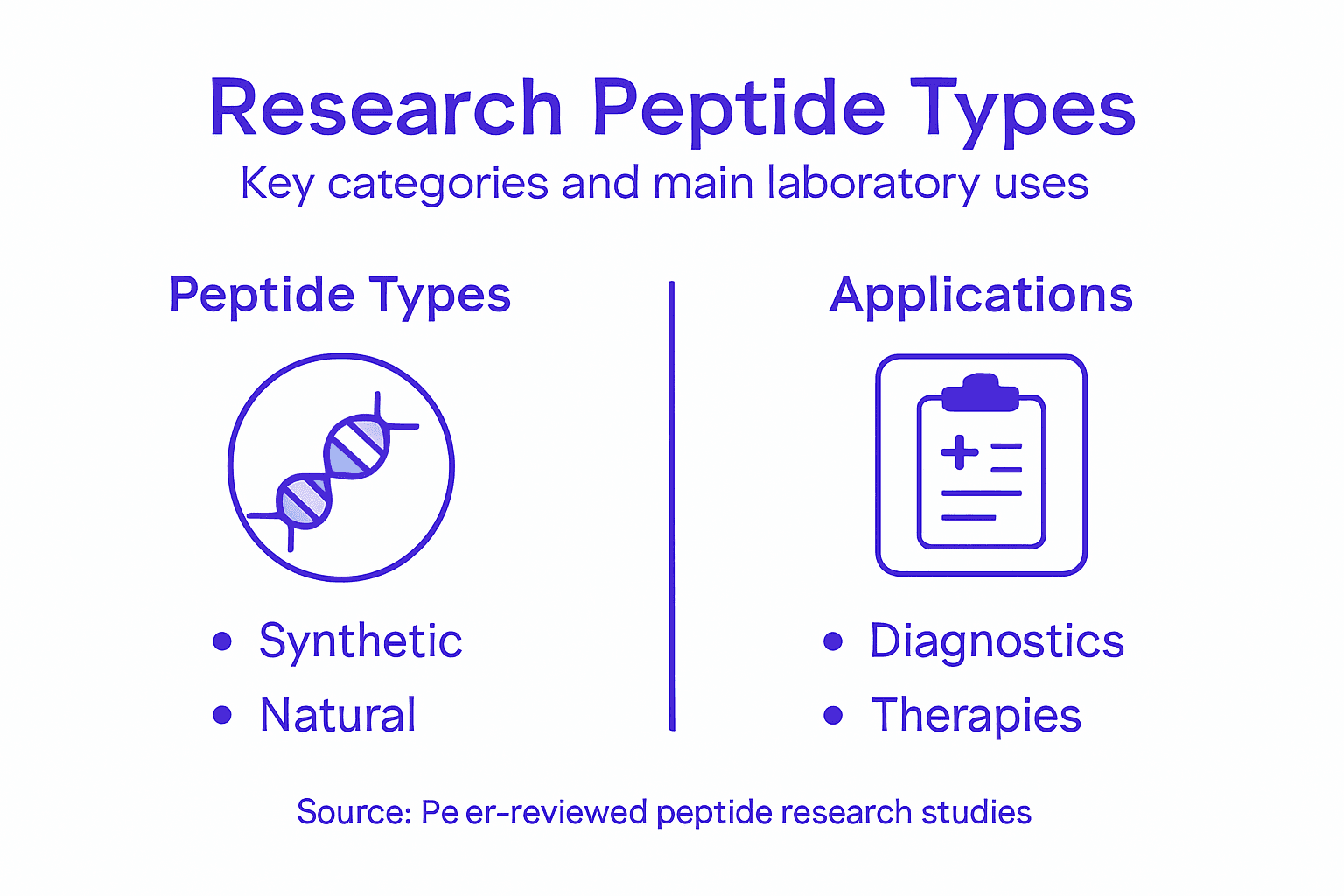
Research peptides represent a dynamic and versatile class of molecular tools with applications spanning multiple scientific domains. Research peptides encompass natural and modified molecular structures designed to address complex experimental challenges across therapeutic and investigative landscapes.
Key categories of research peptides include:
Therapeutic peptides: Targeting specific disease mechanisms
Diagnostic peptides: Used for molecular imaging and detection
Antimicrobial peptides: Investigating infection control strategies
Hormone-modulating peptides: Exploring endocrine system interactions
Receptor-targeted peptides: Examining cellular signaling pathways
These peptide varieties offer researchers unprecedented opportunities for molecular manipulation. Synthesis methods range from chemical production to advanced biological engineering, enabling precise structural modifications tailored to specific research requirements.
Research applications demonstrate remarkable breadth, including:
The following table summarizes the main categories of research peptides alongside their primary use and typical research settings:
Peptide Category | Primary Use | Common Research Setting |
Therapeutic Peptides | Disease mechanism targeting | Preclinical and clinical studies |
Diagnostic Peptides | Imaging and molecular tests | Medical diagnostics laboratories |
Antimicrobial Peptides | Infection control research | Microbiology and drug discovery |
Hormone-modulating | Endocrine system exploration | Metabolic and hormonal studies |
Receptor-targeted | Cell signaling analysis | Cell biology and pharmacology |
Cancer treatment investigations
Metabolic disorder studies
Infectious disease research
Receptor interaction mapping
Molecular targeting strategies
Peptides represent a transformative molecular toolkit, bridging theoretical understanding and practical experimental application across scientific disciplines.
Pro tip: Always validate peptide purity and structural integrity before integrating them into complex research protocols to ensure reproducible and reliable experimental outcomes.
Mechanisms of Action in Experimental Models
Experimental peptide research reveals complex molecular interactions that drive sophisticated biological responses. Peptide mechanisms involve intricate receptor interactions that modulate cellular signaling pathways with remarkable precision and specificity.
Key mechanisms of action in experimental models encompass multiple critical pathways:
Receptor Modulation: Directly influencing cellular receptor activity
Immune Response Activation: Triggering targeted immunological reactions
Signaling Pathway Regulation: Controlling intracellular communication networks
Enzyme Interaction: Inhibiting or stimulating specific enzymatic processes
Molecular Targeting: Precise intervention at cellular and subcellular levels
The experimental landscape demonstrates peptides’ versatility through several fundamental interaction strategies. Immune response mechanisms showcase how peptides participate in complex molecular recognition processes, particularly through Major Histocompatibility Complex interactions.
Researchers can observe multiple experimental action mechanisms:
Receptor agonism and antagonism
Cellular signaling pathway modulation
Inflammatory response regulation
Metabolic process intervention
Protein-protein interaction disruption
Peptides function as sophisticated molecular switches, enabling researchers to precisely manipulate biological systems with unprecedented control.
Pro tip: Systematically document peptide interaction profiles and validate experimental observations across multiple model systems to ensure comprehensive mechanistic understanding.
Purity Requirements and Quality Control Standards
In scientific research, peptide purity represents a critical determinant of experimental reliability and reproducibility. Rigorous quality control processes are fundamental to ensuring the integrity of peptide-based investigations across diverse research domains.
Key quality control standards encompass multiple comprehensive assessment techniques:
Chromatographic Analysis: Separating and identifying molecular components
Mass Spectrometry: Precise molecular weight and composition determination
Nuclear Magnetic Resonance (NMR): Structural verification and impurity detection
High-Performance Liquid Chromatography (HPLC): Quantitative purity evaluation
Elemental Composition Analysis: Confirming molecular structural accuracy
Quality control techniques validate peptide research standards through multiple sophisticated analytical methodologies. Researchers must implement comprehensive verification processes that address both chemical composition and biological activity to maintain experimental credibility.

Purity assessment involves multiple critical parameters:
Here is a comparison of key quality control techniques and what each method assesses for peptide purity:
Technique | What It Assesses |
Chromatographic Analysis | Separation and component identity |
Mass Spectrometry | Molecular weight and composition |
Nuclear Magnetic Resonance | Structural accuracy and impurities |
HPLC | Quantitative purity measurement |
Elemental Composition | Atom-level structural confirmation |
Molecular weight confirmation
Impurity percentage quantification
Structural integrity validation
Batch-to-batch consistency verification
Biological activity assessment
Peptide research demands unwavering commitment to precision, where even minor contaminants can significantly compromise experimental outcomes.
Pro tip: Develop a systematic documentation protocol for each peptide batch, recording detailed purity metrics and analytical validation results to ensure long-term research reproducibility.
Regulatory Compliance and Safe Laboratory Use
Research involving peptides demands meticulous attention to regulatory standards and safety protocols. Comprehensive regulatory frameworks govern peptide research to ensure ethical scientific practices and protect researchers from potential biological hazards.
Key regulatory compliance requirements include:
Institutional Review Board (IRB) Approval
Biosafety Level Adherence
Proper Documentation Protocols
Personal Protective Equipment Standards
Hazardous Material Handling Guidelines
Safe laboratory procedures protect researchers and scientific integrity through systematic risk management and standardized operational guidelines. Researchers must implement comprehensive safety strategies that address multiple dimensions of peptide manipulation.
Critical safety considerations encompass:
Specialized storage conditions
Controlled access to research materials
Precise handling and disposal protocols
Chemical compatibility assessments
Emergency response preparation
Regulatory compliance is not merely a bureaucratic requirement, but a fundamental commitment to scientific ethics and researcher safety.
Pro tip: Develop a comprehensive safety training program that includes hands-on demonstrations of peptide handling techniques and potential hazard mitigation strategies.
Elevate Your Research with Premier Aminos High-Purity Peptides
The article highlights a critical challenge faced by researchers: ensuring molecular purity and precise structural characterization to deliver consistent and reliable experimental outcomes. This need for rigorous quality control, combined with peptide versatility in receptor targeting and biochemical interactions, demands access to dependable peptide sources. At Premier Aminos, we understand these exact pain points and offer an extensive selection of research-grade peptides such as Tesamorelin backed by third-party lab testing and Certificates of Analysis (COAs). Our products meet or exceed 99 percent purity standards to support your experimental success with confidence.
Unlock the full potential of your peptide research by choosing peptides that guarantee reproducibility and regulatory compliance. Explore our carefully curated collection starting with our Research Peptides | Premier Aminos category, designed for targeted receptor modulation studies and therapeutic applications.
Elevate your laboratory work today with high-purity peptides from Premier Aminos. Benefit from fast U.S. shipping, bulk discounts, and unparalleled transparency in peptide quality. Visit our Capsules | Premier Aminos for versatile delivery options and secure your peptide supply now to avoid experimental delays and enhance reproducibility.
Frequently Asked Questions
What are peptides and what role do they play in scientific research?
Peptides are short chains of amino acids linked by amide bonds, serving as essential building blocks for exploring complex biological interactions in various research domains.
How do researchers ensure the purity of peptides used in experiments?
Researchers utilize several quality control techniques, including chromatographic analysis, mass spectrometry, and high-performance liquid chromatography (HPLC) to validate the purity and structural integrity of peptides.
What are some common applications of research peptides in experiments?
Research peptides are used in therapeutic applications, molecular imaging, antimicrobial research, hormone modulation studies, and receptor targeting to understand disease mechanisms and cellular signaling pathways.
What safety protocols should be followed when handling peptides in a laboratory setting?
Key safety protocols include adhering to proper documentation, using personal protective equipment, ensuring safe handling and storage conditions, and following hazardous material handling guidelines.
Recommended


Comments