

How to Choose Peptides for Research: Step-by-Step Guide


Choosing the right peptide supplier can quickly become a critical decision for any research project. In American biomedical and biotech laboratories, even a small oversight in peptide selection may delay experiments or impact reproducibility. A focus on stringent quality controls and clear documentation ensures you receive consistent, high-purity peptides tailored to your protocol. This guide shows how to set requirements, evaluate suppliers, and confidently source materials that meet demanding research standards.
Table of Contents
Quick Summary
Key Point | Explanation |
1. Define research requirements | Clearly outline peptide sequences, purity, and quantities needed for specific experiments. This prevents delays and errors in procurement. |
2. Compare supplier quality | Evaluate suppliers based on their testing documentation, quality control processes, and third-party verification to ensure peptide integrity. |
3. Review Certificates of Analysis | Always request COAs before purchase to validate purity and identity of peptides through reputable third-party testing. |
4. Ensure regulatory compliance | Confirm that peptides are labeled ‘For Research Use Only’ and verify the purity claims with supporting documentation from suppliers. |
5. Document all requirements | Keep a checklist detailing all specifications for reference, aiding in supplier evaluation and communication throughout the procurement process. |
Step 1: Define research requirements for peptide selection
Defining your research requirements is the foundation of successful peptide procurement. This step determines which peptides you need, in what quantities, and at what purity levels. Getting this right upfront saves time and prevents costly procurement mistakes.
Start by clarifying your experimental goals. Ask yourself what specific outcomes you’re trying to achieve. Are you studying cellular signaling pathways, testing therapeutic potential, or validating a new assay? Your research question directly shapes which peptides will serve your work.
Next, identify the specific peptide sequence you require. You may already have this from published literature, previous experiments, or collaborative partners. If you’re exploring a peptide family, document all variants you might need. This prevents returning to suppliers multiple times.
Consider these practical requirements for your selection:
Purity standards your experiments demand (typically ≥99% for research applications)
Quantity needed for initial experiments plus repeat runs
Delivery timeline for your research schedule
Storage conditions and shelf life requirements
Chemical modifications or special formulations
Documentation needs such as Certificates of Analysis for regulatory or publication purposes
Determine whether you need standard off-the-shelf peptides or custom synthesis. Most common research peptides are available as stock items, reducing wait times and cost. Custom peptides take longer but offer flexibility for specialized applications.
Here’s a side-by-side comparison of standard (off-the-shelf) and custom peptide procurement to help guide your selection:
Procurement Type | Turnaround Time | Flexibility for Research | Cost Impact |
Standard (Stock) | Usually 2-7 days | Limited—fixed sequences only | Lower due to mass production |
Custom Synthesis | Typically 1-3 weeks | High—sequence and modifications tailored | Higher for unique requests |
Think about your quality assurance expectations. Research-grade peptides should come with third-party testing documentation verifying purity and identity. This matters whether you’re publishing results or submitting to regulatory bodies.
Your research requirements document becomes your procurement specification, preventing miscommunication with suppliers and ensuring you receive exactly what your experiments need.
Document all these requirements in writing. Create a simple checklist that includes peptide sequence, purity requirement, quantity, delivery date, and any special handling notes. This becomes your reference point when evaluating suppliers.
Pro tip: Start with pilot quantities if testing a new peptide or supplier, then scale up once you’ve confirmed the material performs in your system.
Step 2: Compare suppliers for quality and documentation standards
Comparing suppliers is where your research requirements meet real-world options. You need to evaluate which suppliers can consistently deliver peptides that match your specifications and documentation needs.

Start by identifying potential suppliers in your field. Ask colleagues which vendors they trust, check published research to see who supplies commonly used peptides, and search for suppliers specializing in research-grade materials. Build a shortlist of three to five candidates.
Request detailed information from each supplier. Ask about their quality control processes, testing protocols, and certification standards. A reliable vendor should readily provide specifications for every peptide they offer.
Evaluate these critical quality indicators:
Third-party testing documentation showing independent verification of purity
Certificates of Analysis (COAs) with lot-specific data for each batch
Purity guarantees clearly stated (look for ≥99% for research applications)
Storage and stability information relevant to your lab conditions
Contamination testing for endotoxins or other impurities
Identity verification methods such as mass spectrometry results
Check whether suppliers provide industry standards for peptide suppliers compliance documentation. Reputable vendors demonstrate adherence to established quality benchmarks and regulatory expectations.
Compare pricing and minimum order quantities across suppliers. Lower cost means nothing if the peptide fails your assay or experiments require repeated runs due to quality issues. Factor in shipping speed and whether suppliers offer bulk discounts for larger orders.
Review each supplier’s communication practices. Can you reach someone with technical knowledge to answer questions about peptide specifications? Do they provide documentation promptly? Responsive suppliers prevent delays when problems arise.
A supplier offering comprehensive documentation and responsive support saves months of troubleshooting and protects the integrity of your research.
Check for any certifications or accreditations indicating quality commitment. Some suppliers maintain ISO registrations or follow Good Manufacturing Practices (GMP). These credentials provide additional confidence in their processes.
Pro tip: Order a single peptide from your top two candidates, run parallel experiments, and compare results before committing to a larger supplier relationship.
Step 3: Review lab testing results and Certificates of Analysis
Reviewing lab testing results is where you verify that the peptide you’re purchasing actually meets your specifications. Certificates of Analysis (COAs) are your proof that independent testing confirms purity, identity, and quality.
Request the COA before making a purchase commitment. A complete COA should include the peptide name, sequence, lot number, manufacturing date, and expiration date. This document ties quality results to the exact batch you’ll receive.
Look for these essential testing components in the COA:
High-Performance Liquid Chromatography (HPLC) results showing purity percentage
Mass spectrometry data confirming molecular weight and identity
Water content analysis ensuring proper hydration levels
Endotoxin testing verifying absence of bacterial contamination
Microbial testing for sterility and contamination
Certificate authentication with laboratory name and accreditation information
Verify that testing came from an independent third-party laboratory, not the manufacturer’s internal testing alone. Third-party validation provides unbiased confirmation of quality claims.
Compare the purity results against your research requirements. Most research-grade peptides should show ≥99% purity. If a COA shows lower purity, understand what the impurities are and whether they’ll affect your experiments. Some impurities matter more than others depending on your application.
Check the lot-specific nature of the data. Generic COAs applying to all batches offer less assurance than lot-specific documentation showing results for your exact peptide batch. Lot-specific COAs prove that quality control happened for your material.
Examine the testing dates. Recent testing indicates fresher material. Peptides degrade over time, so testing dates close to your purchase date provide better confidence in current quality.
A detailed, lot-specific COA from an independent laboratory is your insurance policy that the peptide performs as expected in your research.
Request clarification on any test results you don’t understand. Trustworthy suppliers can explain how to verify peptide purity methodology and answer technical questions about testing standards.
Pro tip: Save all COAs with your research documentation for publication purposes and regulatory compliance, organizing them by lot number and purchase date for easy reference.
Step 4: Validate regulatory compliance and purity claims
Validating regulatory compliance ensures that the peptides you purchase meet established standards and that purity claims are legitimate. This step protects your research from contaminated or mislabeled materials that could compromise results.
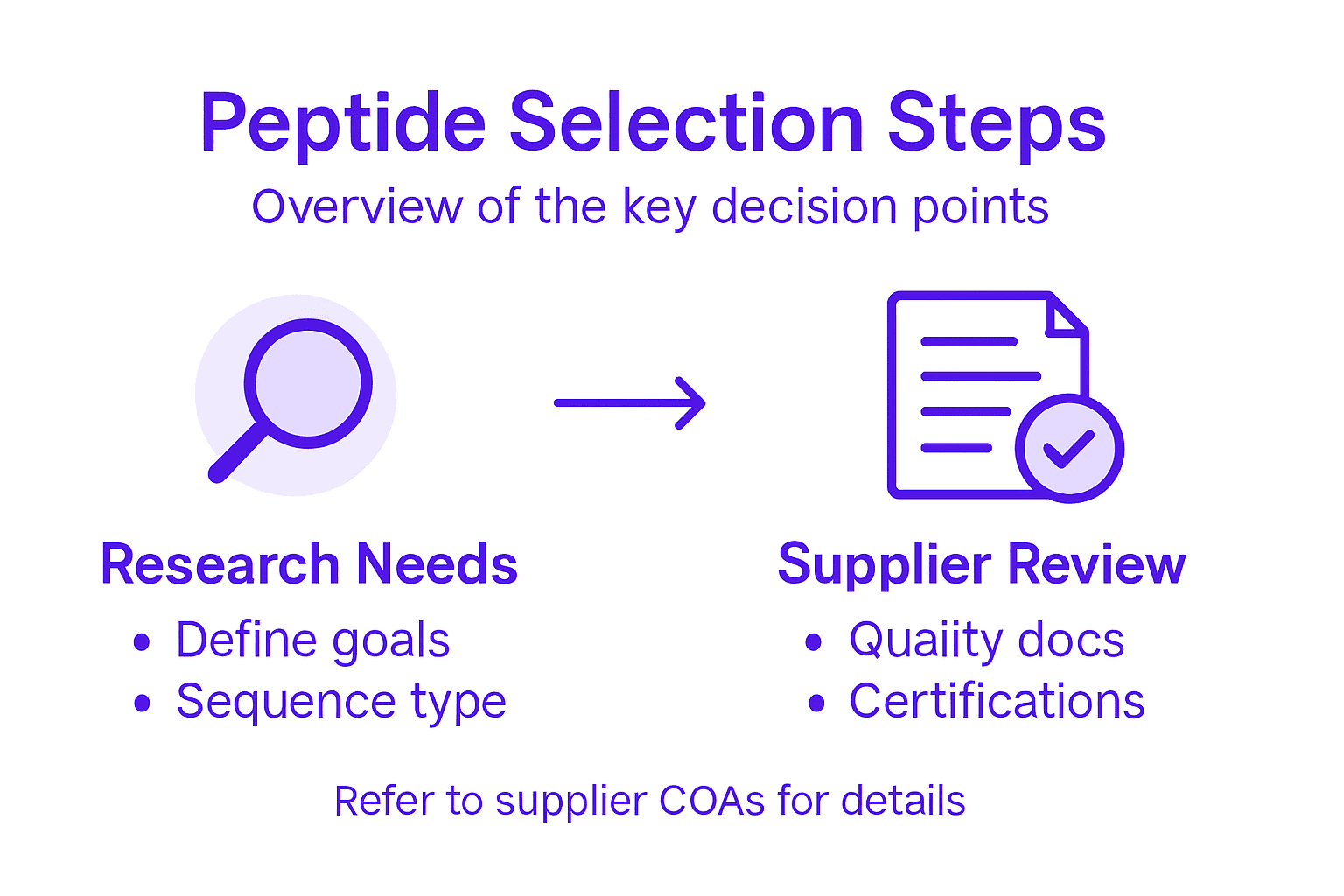
Start by understanding what “research-grade” actually means. Research-grade peptides are not approved for human consumption and must meet specific purity and quality standards for laboratory use. Verify that your supplier clearly labels products as research-only and not for human use.
Check supplier claims against verifiable documentation. Don’t accept marketing language alone. Look for specific, measurable purity percentages backed by third-party testing. A supplier claiming ≥99% purity without supporting data is making an unverifiable promise.
Review these regulatory indicators:
Product labeling clearly stating “For Research Use Only” or “Not for Human Consumption”
Test methodology standards such as HPLC, mass spectrometry, or other validated techniques
Laboratory accreditations such as ISO certifications or Good Manufacturing Practice (GMP) compliance
Batch-specific documentation proving each lot underwent quality testing
Supplier liability statements accepting responsibility for product quality
Material Safety Data Sheets (MSDS) providing handling and storage information
Understand that peptide purity standards vary based on research application. Different experiments require different purity levels. A peptide suitable for cell culture studies may not meet standards for in vivo research or publication in high-impact journals.
Verify the supplier’s compliance with U.S. regulations governing research materials. Reputable suppliers maintain records demonstrating adherence to FDA guidelines for research products and can provide documentation on request.
Look for transparency about quality control processes. Can the supplier explain their testing methodology? Do they document chain of custody from manufacture to shipment? Transparent suppliers who answer detailed questions demonstrate commitment to quality.
Regulatory compliance isn’t about restriction—it’s about assurance that your peptide meets established standards for research integrity.
Ask suppliers directly about their quality certifications and testing protocols. Request copies of accreditation documents and validation reports. Any legitimate supplier welcomes these questions.
Use this reference table to quickly check which regulatory documents and credentials you should verify from a supplier:
Item | What It Confirms | Source to Request |
Certificate of Analysis | Purity & Identity | Supplier or Third-Party Lab |
ISO/GMP Certification | Quality Processes | Supplier Sales/QA Team |
Material Safety Data Sheet | Safe Handling Directions | Supplier Documentation |
Regulatory Compliance Letter | Legal status for research | Regulatory Affairs Contact |
Pro tip: Keep a spreadsheet documenting each supplier’s compliance credentials, testing standards, and certification dates, making it easy to verify continued compliance and support regulatory audits of your research.
Ensure Quality and Purity with Premier Aminos for Your Research Peptides
Choosing the right peptides for your experiments involves overcoming challenges like verifying purity, obtaining detailed Certificates of Analysis, and securing reliable suppliers who meet strict research standards. If you want to avoid the frustrations of inconsistent quality or unclear documentation Premier Aminos offers a curated selection of research-grade peptides with ≥99% purity backed by independent third-party lab testing and lot-specific COAs. Whether you need proven peptides like BPC-157 or Ipamorelin we prioritize transparency and regulatory compliance to help you advance your scientific goals confidently.
Explore our range of rigorously tested peptides including those found under our Capsules | Premier Aminos and Topicals | Premier Aminos categories. Act now to secure your research materials with fast U.S. shipping and bulk discounts that save you time and cost. Visit Premier Aminos today and experience procurement made simple without compromising on quality or documentation.
Frequently Asked Questions
How do I define my research requirements for peptide selection?
To define your research requirements, clarify your experimental goals, such as the specific outcomes you’re trying to achieve. Create a checklist that includes peptide sequence, purity requirements, quantity, delivery timeline, and any special handling needs.
What factors should I consider when comparing peptide suppliers?
Compare peptide suppliers based on quality control processes, third-party testing documentation, and compliance with industry standards. Request information like Certificates of Analysis and compare pricing and shipping speeds to find the best option for your needs.
What should I look for in a Certificate of Analysis (COA)?
A COA should include the peptide name, sequence, lot number, and test results for purity percentage, mass spectrometry validation, and microbial testing. Ensure that the testing is done by an independent third-party laboratory to validate quality claims.
How can I determine if a peptide is research-grade?
Research-grade peptides are labeled as
Recommended


Comments