

Peptide Labeling Standards Explained: Ensuring Purity and Accuracy

Updated: Sep 5

Finding reliable peptide labeling standards is often more complicated than most researchers expect. Strict regulatory requirements and evolving FDA guidelines demand precision, but common misconceptions can lead even seasoned American scientists astray. Peptides require rigorous quality assessment across identity, purity, and molecular integrity to ensure experimental reproducibility and safety. This guide will help you navigate the nuances of peptide labeling, from evaluating purity documentation to understanding advanced quality controls, so you can make confident, informed choices for your laboratory.
Table of Contents
Key Takeaways
Point | Details |
Peptide Labeling Standards | Establishing peptide labeling standards is vital for research integrity, ensuring precise quality metrics like identity, purity, and molecular weight. |
Common Misconceptions | Misunderstandings about peptide labeling can undermine research; for example, identical sequences do not guarantee identical products due to variations in production and storage. |
Purity Documentation | Adhering to rigorous purity requirements and maintaining comprehensive documentation, such as Certificates of Analysis, is essential for validating peptide quality. |
Accurate Labeling | Accurate labeling plays a crucial role in research safety and integrity; researchers should implement stringent verification processes to prevent mislabeling risks. |
Defining Peptide Labeling Standards and Common Misconceptions
Peptide labeling standards represent a critical framework for ensuring research integrity and reproducibility in scientific investigations. Regulatory guidelines for peptide characterization highlight the complex process of defining precise quality metrics for these molecular structures.
At their core, peptide labeling standards involve a comprehensive assessment of several key parameters that guarantee product reliability:
Identity verification: Confirming the exact amino acid sequence
Purity measurement: Determining percentage of target molecule
Molecular weight validation: Precisely calculating peptide mass
Impurity characterization: Identifying potential contaminants
Researchers frequently encounter misconceptions about peptide labeling that can compromise experimental outcomes. One prevalent myth suggests that all peptides are identical if they share the same sequence. However, production methods, manufacturing conditions, and storage protocols significantly impact molecular integrity.
Understanding the nuanced landscape of peptide quality requires recognizing that synthetic and recombinant peptides have unique production challenges. Regulatory bodies like the FDA evaluate peptides across multiple dimensions, including chemical structure, potential degradation products, and manufacturing consistency.
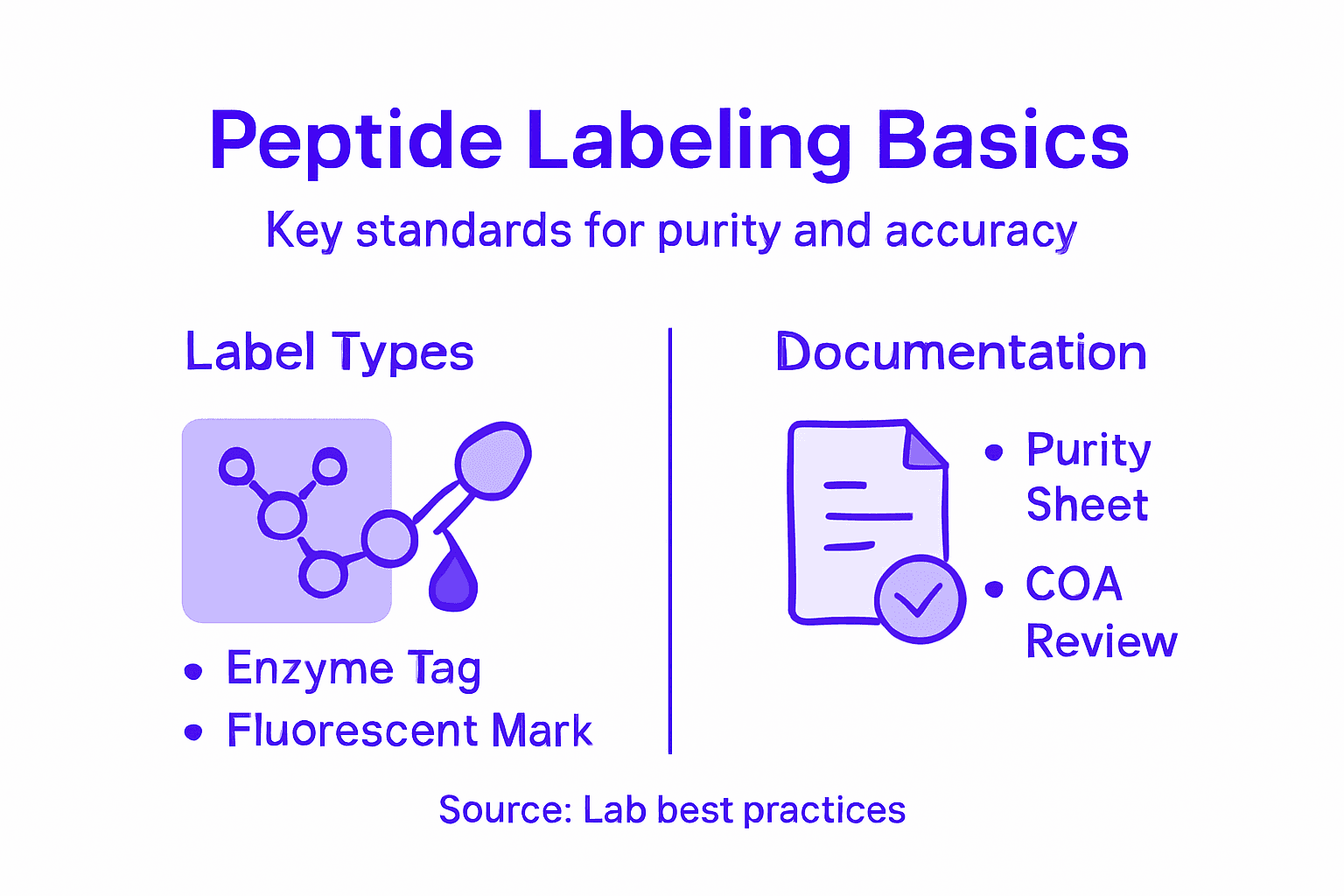
Pro tip: Always request and review the Certificate of Analysis (COA) for peptide batches to verify precise quality metrics and ensure research reproducibility.
Types of Peptide Labels and Key Distinctions
Peptide labeling represents a sophisticated approach to molecular tracking and research identification, with diverse strategies for protein modification enabling precise scientific investigation. Researchers have developed multiple techniques to tag and track peptides, each with unique characteristics and potential applications.
The primary categories of peptide labels include:
Enzyme-mediated labels: Utilizing specific enzymatic reactions for attachment
Metal ion recognition labels: Leveraging metal-binding properties
Small molecule interaction labels: Enabling targeted molecular interactions
Peptide-peptide interaction labels: Utilizing complementary peptide sequences
When classifying peptides, scientists consider multiple critical dimensions. Antimicrobial peptide classification demonstrates the complexity of this process, which typically involves examining:
Chemical structure
Molecular charge
Amino acid composition
Biological function
Origin (synthetic versus natural)
Each labeling method presents unique advantages and potential limitations. Enzyme-based tags offer high specificity but may slightly increase protein size, potentially impacting molecular behavior. Smaller peptide-based approaches provide more nuanced modifications with minimal structural disruption.
Here’s a quick comparison of common peptide labeling strategies and their research impact:
Label Type | Application Area | Advantages | Limitation |
Enzyme-mediated | Proteomics, biomarker studies | High specificity | May increase protein size |
Metal ion recognition | Imaging, purification | Easily detected | Can affect peptide stability |
Small molecule interaction | Target binding, tracking | Versatile compatibility | May alter function |
Peptide-peptide interaction | Complex assembly, drug delivery | Minimal structure disruption | Limited interaction targets |
Pro tip: Carefully evaluate the specific research requirements and potential molecular interactions before selecting a peptide labeling strategy to ensure optimal experimental outcomes.
Purity Requirements and Documentation Standards
Ensuring peptide purity represents a critical cornerstone of scientific research and pharmaceutical development. Analytical methods for impurity characterization provide researchers with sophisticated techniques to validate molecular integrity and quality.
Key documentation standards for peptide purity encompass several crucial components:
Detailed specifications: Comprehensive molecular characterization
Acceptance criteria: Precise purity thresholds
Stability testing: Long-term molecular performance evaluation
Impurity profiling: Systematic identification of molecular variations
USP standards for peptide quality establish rigorous frameworks for assessing peptide therapeutics. Advanced analytical techniques like high-performance liquid chromatography (HPLC) and high-resolution mass spectrometry enable researchers to detect and quantify:
Sequence variants
Process-related impurities
Potential degradation products
Trace contaminants
Molecular structural anomalies
Research-grade peptides require meticulous documentation demonstrating molecular consistency, with typical purity standards ranging from 95% to 99.9%. Comprehensive Certificates of Analysis (COAs) provide transparent documentation of these critical quality metrics, supporting reproducibility and scientific integrity.

This summary shows key peptide purity documentation elements and their research value:
Documentation Element | Role in Research | Benefit |
Specifications | Defines molecular properties | Ensures sample consistency |
Acceptance criteria | Sets quality thresholds | Validates experimental reliability |
Stability testing | Assesses long-term integrity | Confirms batch durability |
Impurity profiling | Detects contaminants | Reduces risk of false results |
Pro tip: Request and thoroughly review the complete Certificate of Analysis before using any peptide in research, paying close attention to purity percentages and impurity profiles.
Labeling Compliance for Research-Only Peptides
Research peptide labeling represents a critical regulatory requirement with significant implications for scientific integrity and safety. FDA guidance for investigational product labeling establishes comprehensive standards to ensure accurate documentation and responsible research conduct.
Essential labeling requirements for research-only peptides include:
Product identity: Clear molecular designation
Intended use: Explicit research-only disclaimer
Storage conditions: Precise environmental specifications
Handling instructions: Detailed safety protocols
Expiration information: Precise dating and stability parameters
USP labeling standards for research materials mandate several critical documentation elements that protect research integrity:
Unambiguous non-clinical use declaration
Comprehensive traceability information
Detailed molecular characterization
Safety warning specifications
Batch-specific tracking codes
Comprehensive labeling serves multiple crucial functions beyond regulatory compliance. It provides researchers with essential information for experimental reproducibility, ensures proper handling, and mitigates potential misuse risks. Advanced labeling protocols include machine-readable codes, QR tracking, and digital documentation systems that enhance transparency and accountability.
Pro tip: Always cross-reference peptide labels with original Certificates of Analysis and maintain a systematic documentation protocol for each research batch.
Risks of Mislabeling and Ensuring Accuracy
FDA guidelines on peptide mislabeling risks underscore the critical importance of precise molecular characterization and documentation. Mislabeling can lead to significant scientific and safety complications that compromise research integrity and potential therapeutic development.
Key risks associated with peptide mislabeling include:
Immunogenic reactions: Unexpected immune system responses
Experimental invalidation: Compromised research outcomes
Safety hazards: Potential health risks from incorrect molecular identification
Regulatory non-compliance: Potential legal and scientific penalties
Cross-contamination: Misidentification of molecular structures
Advanced immunoinformatics strategies have emerged to mitigate mislabeling risks through sophisticated analytical techniques:
Orthogonal testing protocols
T cell epitope detection methods
Comprehensive impurity profiling
Immunogenicity risk assessment
Molecular structure validation
Researchers must implement rigorous verification processes that go beyond standard documentation. This includes multiple layers of verification, cross-referencing molecular databases, and utilizing advanced analytical technologies to confirm peptide identity and purity.
Pro tip: Develop a standardized verification checklist that includes independent molecular validation, batch cross-referencing, and systematic documentation tracking for each peptide sample.
Ensure Research Accuracy with Premier Aminos Quality Peptides
Navigating peptide labeling standards to guarantee purity and accuracy can be challenging for any research institution. The article highlights key issues such as verifying peptide identity, understanding impurity profiles, and complying with strict documentation requirements. If you seek peptides that meet the highest research standards with transparent Certificates of Analysis and purity levels above 99 percent, Premier Aminos offers solutions tailored to your needs.
Explore our full range of rigorously tested products including specialized Research Peptides and research-grade peptides in the All Products | Premier Aminos category. With fast U.S. shipping, third-party lab certifications, and compliance-focused labeling, Premier Aminos is your trusted partner for supply chain reliability and molecular integrity. Visit Premier Aminos to secure the quality peptides your research demands today.
Frequently Asked Questions
What are peptide labeling standards?
Peptide labeling standards are guidelines that ensure the integrity and reproducibility of peptides in scientific research. They involve assessment parameters such as identity verification, purity measurement, molecular weight validation, and impurity characterization.
Why is peptide purity important in research?
Peptide purity is critical because it ensures the reliability of experimental outcomes. High purity levels reduce the risk of false results and enhance the overall quality of scientific investigations.
What are the common types of peptide labels used in research?
Common types of peptide labels include enzyme-mediated labels, metal ion recognition labels, small molecule interaction labels, and peptide-peptide interaction labels. Each type has unique advantages and applications depending on the research needs.
How can I ensure the accuracy of peptide labeling?
To ensure accuracy, it’s essential to request and review a Certificate of Analysis (COA) for each peptide batch. Additionally, implementing rigorous verification processes, including independent molecular validation and cross-referencing databases, can help mitigate mislabeling risks.
Recommended


Comments