_edited.png)

Peptide Research Terminology: Ensuring Clarity and Compliance

Updated: Sep 5

Precision shapes every phase of peptide research, from data reporting to regulatory compliance. Ambiguity in terminology can undermine experimental reliability and jeopardize collaboration across laboratories. Applying Good Manufacturing Practice and ISO certifications alongside standardized peptide nomenclature ensures clear communication, reproducibility, and global research alignment. This overview clarifies the foundational language and protocols essential for accurate peptide documentation, empowering researchers to advance scientific discovery with confidence.
Table of Contents
Key Takeaways
Point | Details |
Precision in Terminology | Accurate peptide nomenclature is essential for maintaining scientific integrity and reproducibility in research. |
Standardized Practices | Consistent application of peptide labeling standards across research teams prevents ambiguity and enhances collaboration. |
Rigorous Quality Control | Implementing thorough quality control measures ensures the reliability of experimental results and adherence to research protocols. |
Comprehensive Documentation | Adhering to stringent documentation standards fosters transparency and enables reproducibility in scientific findings. |
Defining Peptide Research Terminology Accurately
Peptide research demands extraordinary precision in terminology to maintain scientific integrity and reproducibility. Nomenclature serves as the foundational language through which researchers communicate complex molecular structures, interactions, and experimental findings. Misunderstandings or imprecise definitions can compromise entire research trajectories.
Effective peptide terminology encompasses several critical dimensions:
Sequence identification: Precise amino acid order
Molecular weight: Exact calculation of peptide mass
Structural characteristics: Secondary and tertiary configurations
Functional classification: Specific biological roles
Synthetic modification markers: Chemical alterations and derivatizations
Researchers must consistently apply standardized peptide labeling standards to ensure clarity across experimental contexts. These standards help prevent ambiguity and enable seamless knowledge transfer between research groups and institutions.
Scientific communication relies on universally understood descriptors that transcend individual laboratory practices. By adopting rigorous terminology protocols, researchers create a common language that facilitates collaborative understanding and accelerates scientific discovery.
Pro tip: Develop a standardized internal terminology glossary for your research team to maintain consistent peptide nomenclature across all documentation and communications.
Major Categories and Types of Peptides
Peptide research encompasses a diverse array of molecular structures with distinct functional characteristics and scientific applications. Classification of peptides provides researchers with a systematic approach to understanding their complex biological roles and potential experimental uses.
The primary categories of peptides can be broadly categorized into several key types:
Signaling peptides: Molecules that facilitate cellular communication
Structural peptides: Components that provide architectural support
Hormonal peptides: Chemical messengers regulating physiological processes
Antimicrobial peptides: Molecules with defensive biological properties
Enzymatic peptides: Catalytic fragments involved in biochemical reactions
Within these categories, researchers further distinguish peptides based on research peptide impacts such as molecular weight, amino acid sequence, and specific biological functionality. The granularity of classification enables precise experimental design and targeted molecular investigations.
Each peptide category presents unique research opportunities, from investigating cellular signaling mechanisms to developing potential therapeutic interventions. Understanding these nuanced distinctions allows scientists to select appropriate peptide types for specific experimental protocols and research objectives.
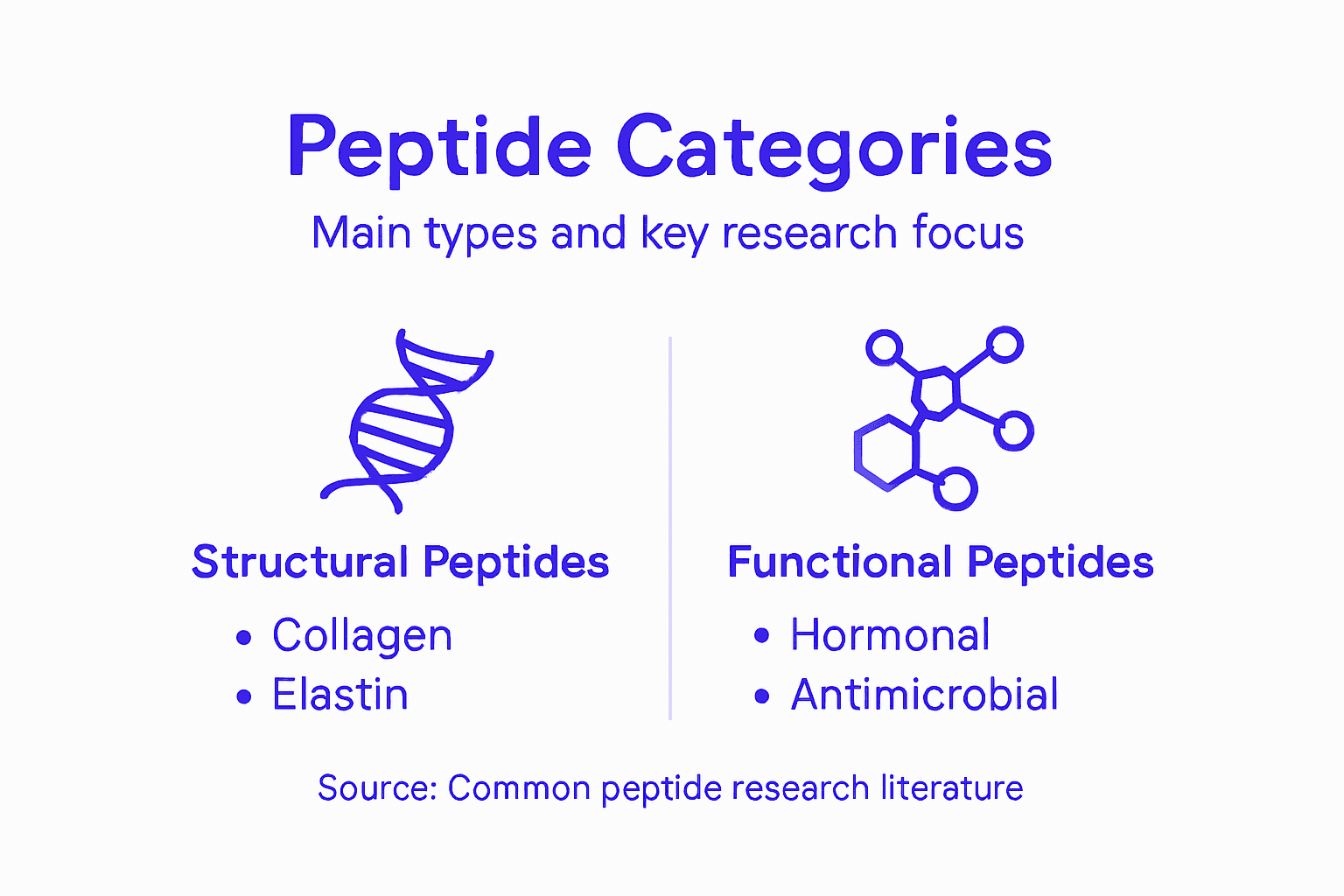
Here’s a quick reference chart summarizing common peptide categories, their primary functions, and typical research applications:
Peptide Category | Main Function | Example Research Application |
Signaling Peptides | Facilitate cell communication | Cellular response analysis |
Structural Peptides | Provide molecular support | Protein folding studies |
Hormonal Peptides | Regulate physiological effects | Endocrine system investigation |
Antimicrobial Peptides | Defend against pathogens | Infection control and therapy research |
Enzymatic Peptides | Catalyze chemical reactions | Enzyme activity profiling |
Pro tip: Maintain a comprehensive reference chart documenting the specific characteristics of different peptide categories to streamline your research workflow and experimental planning.
Key Terms for Purity, Labeling, and Testing
Accurate peptide research demands rigorous standards for purity, labeling, and testing that ensure reproducibility and scientific integrity. Researchers must navigate a complex landscape of analytical techniques and documentation requirements to maintain the highest levels of experimental reliability.
Key terminology and standards for peptide quality control include:
Purity percentage: Quantitative measure of peptide molecular integrity
Lot number: Unique identifier for specific production batch
Certificate of Analysis (COA): Comprehensive quality documentation
Molecular weight verification: Precise mass confirmation
Amino acid sequence validation: Accurate structural identification
Researchers rely on advanced analytical techniques like peptide quality standards including High-Performance Liquid Chromatography (HPLC) and Mass Spectrometry (MS) to ensure peptide molecular integrity and conformity with established scientific protocols.
Quality control processes encompass multiple verification stages, from initial synthesis to final documentation. Each step requires meticulous attention to detail, with standardized protocols that enable consistent, reproducible research across different scientific environments.
Pro tip: Develop a comprehensive checklist for verifying peptide documentation, including purity percentage, lot number, and testing method details before incorporating any new peptide into your research workflow.
Documentation Requirements and Compliance Terms
Research institutions must adhere to stringent documentation standards that ensure the integrity, reproducibility, and scientific validity of peptide research. These comprehensive requirements serve as a critical framework for maintaining transparency and accountability throughout experimental processes.
Key documentation components for peptide research compliance include:
Standard Operating Procedures (SOPs): Detailed experimental protocols
Data management records: Comprehensive tracking of research activities
Ethical approval documentation: Institutional review board certifications
Material transfer agreements: Legal frameworks for peptide research materials
Consent and confidentiality forms: Protecting research participant information
Researchers must meticulously maintain research documentation standards that capture every significant aspect of peptide investigation. This includes detailed logs of experimental conditions, equipment calibration, sample handling, and precise measurement protocols.

Compliance documentation extends beyond simple record-keeping. It represents a fundamental scientific commitment to transparency, allowing other researchers to validate, replicate, and build upon experimental findings. Thorough documentation serves as a critical mechanism for maintaining the highest standards of scientific integrity and knowledge advancement.
Pro tip: Create a digital archiving system with multiple backup locations to ensure comprehensive, secure, and easily retrievable research documentation.
Common Misunderstandings and How to Avoid Them
Navigating the complex landscape of peptide research requires a nuanced understanding of potential pitfalls that can compromise experimental accuracy. Misconceptions about peptide handling, storage, and analysis can dramatically impact research outcomes and scientific validity.
Common peptide research misunderstandings include:
Purity assumptions: Overlooking subtle variations in peptide composition
Storage protocol errors: Improper temperature and humidity management
Contamination risks: Underestimating molecular interaction possibilities
Sequence verification: Neglecting comprehensive structural validation
Experimental reproducibility: Failing to document precise conditions
Researchers must be particularly vigilant about peptide research challenges that can introduce unintended variables. Subtle contamination, improper handling, or inadequate characterization can render entire experimental datasets unreliable or invalid.
Critical thinking and meticulous attention to detail are essential in preventing these common research errors. By understanding potential sources of experimental variation, researchers can develop more robust protocols that enhance the reliability and reproducibility of their scientific investigations.
To help researchers avoid common pitfalls, here is a comparison of best practices versus common errors in peptide research:
Aspect | Best Practice | Common Error |
Purity Assessment | Use rigorous analytical confirmation | Assume supplier claims are accurate |
Storage Management | Maintain stable, controlled conditions | Store at room temperature untracked |
Documentation | Record every procedural detail | Rely on memory or informal notes |
Sequence Validation | Verify with multiple analytic methods | Skip final sequence checks |
Pro tip: Implement a comprehensive quality control checklist for every peptide research stage to systematically identify and mitigate potential sources of experimental error.
Ensure Absolute Clarity and Compliance in Your Peptide Research with Premier Aminos
Navigating the complexities of peptide research terminology is a crucial challenge for ensuring reproducibility and scientific integrity. If you are focused on maintaining precise peptide labeling, purity standards, and compliance documentation, Premier Aminos offers a trusted source of high-quality research-grade peptides that align perfectly with these exacting demands. Our curated selection, including emphasizes ≥99% purity, verified through third-party lab testing and supported by detailed Certificates of Analysis. This lets you confidently integrate peptides into your research while fully meeting documentation and regulatory expectations.
Experience reliable product transparency combined with fast U.S. shipping and bulk purchasing options when you visit Premier Aminos. Take the next step to streamline your peptide procurement and uphold rigorous research standards by exploring our full range at All Products | Premier Aminos. Don’t let ambiguity or compliance issues slow your progress. Act now to ensure your research benefits from precision, quality, and consistency.
Frequently Asked Questions
What are the essential components of peptide research terminology?
Key components include sequence identification, molecular weight, structural characteristics, functional classification, and synthetic modification markers.
How can researchers ensure clarity in peptide nomenclature?
Researchers can ensure clarity by consistently applying standardized peptide labeling standards and developing internal terminology glossaries.
What are the main categories of peptides and their functions?
Peptides are categorized into signaling peptides, structural peptides, hormonal peptides, antimicrobial peptides, and enzymatic peptides, each serving distinct biological roles.
Why is proper documentation critical in peptide research?
Proper documentation is critical for maintaining transparency, reproducibility, and scientific integrity, including components like Standard Operating Procedures, data management records, and ethical approval documentation.
Recommended


Comments