

Purity in Laboratory Peptides: Why Accuracy Matters

Updated: Sep 5

Finding consistent, high-purity peptides for metabolic disorder studies and therapeutic research can challenge even the most experienced scientists. Each batch must meet exacting standards, since even trace-level impurities may dramatically skew experimental results or provoke unwanted biological responses. American laboratories know that verified purity, validated by advanced analytical methods and trusted suppliers, safeguards the reliability of their findings. This article clarifies how purity levels shape experimental reproducibility and highlights the steps researchers should take to secure dependable peptide sources for bulk procurement.
Table of Contents
Key Takeaways
Point | Details |
Peptide Purity Measurement is Essential | Accurate quantification of peptide purity is crucial for experimental reproducibility and data reliability. |
Analytical Techniques Are Key | Employing advanced analytical methods like HPLC and Mass Spectrometry provides comprehensive insights into molecular integrity and purity. |
Impurities Can Compromise Results | Even trace impurities can significantly distort experimental outcomes, emphasizing the need for rigorous quality control. |
Vendor Verification is Critical | Ensuring reliable procurement through vendor certification and third-party testing helps maintain the integrity of research materials. |
Defining Peptide Purity in Research Labs
In scientific research, peptide purity represents the precise percentage of target molecules present in a laboratory sample, reflecting the absolute chemical accuracy critical for reliable experimental outcomes. Researchers rely on stringent purity measurements to ensure experimental reproducibility and prevent potential data contamination.
Peptide purity is typically quantified through sophisticated analytical techniques that provide detailed molecular composition analysis:
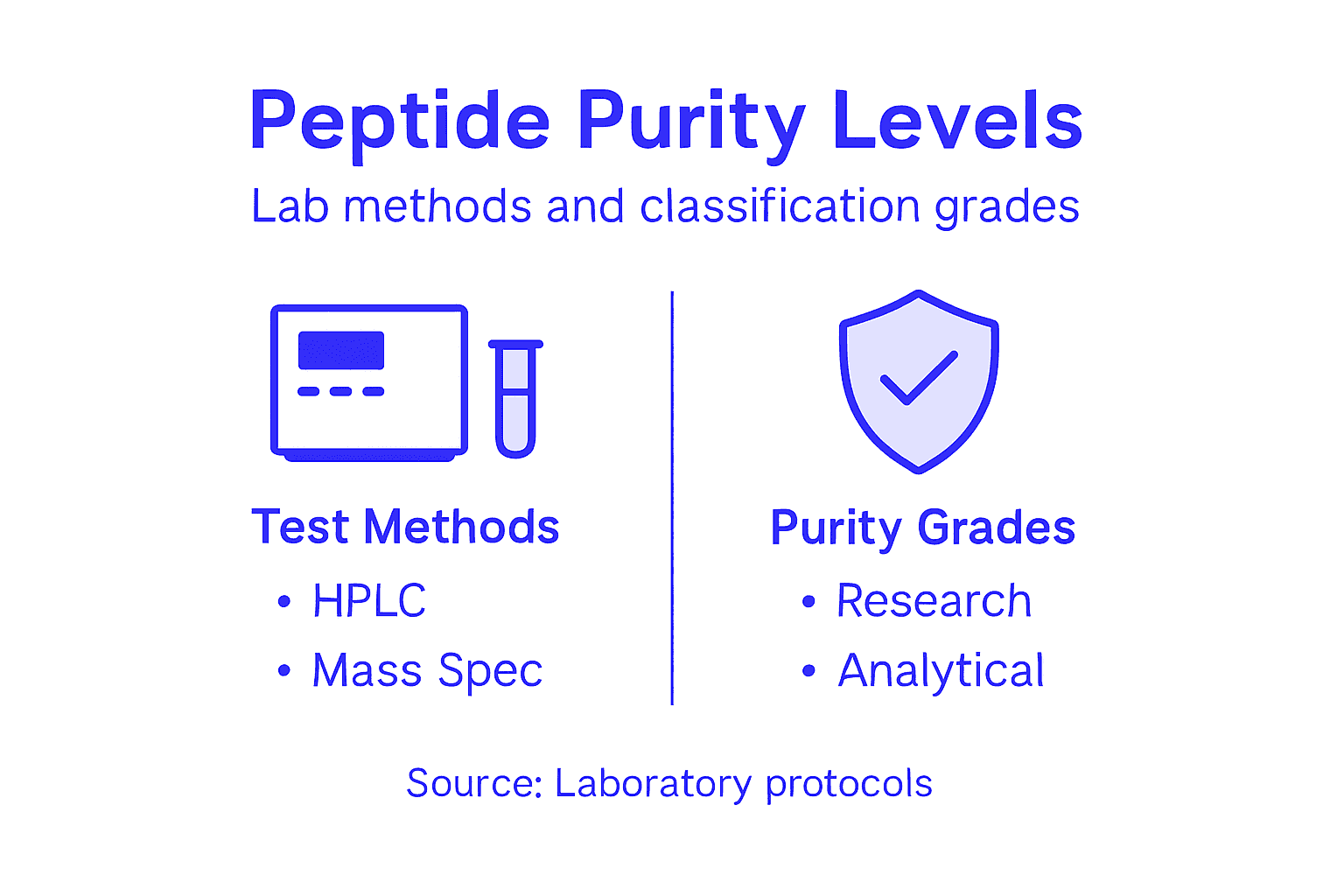
High-Performance Liquid Chromatography (HPLC) for separating molecular components
Mass Spectrometry for identifying molecular weight and structural composition
Amino Acid Analysis for verifying exact peptide sequence integrity
UV Spectroscopy for determining concentration and molecular purity percentages
Molecular researchers recognize that even minor impurities can dramatically skew experimental results. Third-party testing protocols provide critical validation of peptide quality, ensuring researchers receive compounds meeting rigorous scientific standards.
Purity standards in laboratory peptides are typically categorized across specific grade levels:
Research Grade: ≥95% molecular purity
Analytical Reference Standard: ≥98% molecular purity
Pharmaceutical Grade: ≥99% molecular purity
Accurate peptide purity measurements require advanced technological capabilities and meticulous laboratory protocols. Researchers must consistently validate their peptide samples to maintain experimental integrity and prevent potential cross-contamination that could compromise scientific investigations.
Pro tip: Always request and review a Certificate of Analysis (COA) for your peptide samples to confirm precise molecular composition and purity levels.
Purity Standards and Classification Levels
Peptide purity standards are critical scientific benchmarks that define the molecular composition and reliability of research compounds. Peptide purity classification provides researchers with essential guidelines for selecting appropriate materials based on specific experimental requirements and precision needs.
Research laboratories typically categorize peptide purity across multiple grade levels, each designed for specific scientific applications:
Crude Peptides (>70% purity): Suitable for basic antibody generation
Low Purity Grade (80-85% purity): Appropriate for preliminary screening studies
Research Grade (85-95% purity): Ideal for enzyme assays and initial biological activity studies
Analytical Grade (95-98% purity): Recommended for quantitative analysis and advanced research
High Purity/Clinical Grade (>98% purity): Essential for clinical trials and industrial standards
The selection of peptide purity directly impacts experimental outcomes and data integrity. Minor variations in molecular composition can significantly alter research results, making precise purity assessment crucial for reproducible scientific investigations.
Purity determination involves comprehensive analytical techniques that provide molecular-level insights:
Quantify total peptide content
Identify potential contaminants
Verify molecular weight and structural integrity
Assess amino acid sequence accuracy
Evaluate potential chemical modifications
Higher purity levels correlate directly with increased experimental reliability and reduced potential for unintended molecular interactions.
Researchers must carefully match peptide purity levels with their specific experimental protocols, considering factors such as sensitivity, specificity, and potential downstream applications.

Pro tip: Always document the exact purity level and source of your peptide samples to ensure complete traceability and reproducibility in your research findings.
How Laboratory Peptide Purity Is Tested
Laboratory peptide purity testing represents a critical scientific process involving sophisticated analytical techniques that provide comprehensive molecular-level assessments. Premier Aminos blog highlights the intricate methodologies researchers employ to ensure precise peptide characterization and quality control.
Scientific laboratories utilize multiple advanced analytical techniques to evaluate peptide purity and molecular integrity:
High-Performance Liquid Chromatography (HPLC): Separates molecular components with exceptional precision
Mass Spectrometry (MS): Determines exact molecular weight and structural composition
Amino Acid Analysis: Verifies complete peptide sequence and potential modifications
Capillary Electrophoresis: Identifies trace impurities and molecular variations
Nuclear Magnetic Resonance (NMR): Provides detailed structural insights
Each analytical method offers unique advantages in assessing peptide molecular characteristics. HPLC remains the gold standard for quantitative purity analysis, capable of separating complex molecular mixtures with remarkable accuracy. This technique allows researchers to:
Here is a quick reference for analytical methods used in peptide purity assessment:
Technique | Primary Purpose | Key Benefit |
HPLC | Quantitative purity analysis | Separates mixture components |
Mass Spectrometry | Molecule identification | Confirms molecular structure |
Amino Acid Analysis | Sequence validation | Detects peptide modifications |
UV Spectroscopy | Concentration measurement | Fast estimation of purity |
NMR | Structural elucidation | Detailed molecular insights |
Capillary Electrophoresis | Impurity detection | High sensitivity for trace contaminants |
Measure total peptide content
Identify potential contaminants
Calculate precise percentage of target molecules
Detect unexpected molecular variations
Ensure batch-to-batch consistency
Rigorous purity testing is not just a scientific protocol, but a fundamental requirement for generating reliable and reproducible research results.
Advanced testing protocols typically involve multiple complementary analytical techniques to provide comprehensive molecular characterization. Researchers cross-reference results from different methods to ensure maximum accuracy and eliminate potential measurement uncertainties.
Pro tip: Request comprehensive Certificates of Analysis that detail multiple testing methodologies to validate the complete molecular profile of your peptide samples.
Consequences of Impurities in Experiments
Peptide impurities represent a critical challenge in scientific research, potentially undermining entire experimental outcomes and research integrity. Peptide-related impurities can arise from multiple sources during synthesis, storage, and transportation, introducing significant variability into research protocols.
Scientific research identifies several key types of peptide impurities that can dramatically impact experimental results:
Dimers: Molecular complexes formed by peptide bonding
Oxidized Products: Chemical modifications altering molecular structure
Truncated Sequences: Incomplete peptide chains
Degradation Products: Molecules resulting from chemical breakdown
Isomeric Variations: Alternative molecular configurations
These impurities can produce profound experimental consequences, including:
Skewing quantitative measurements
Generating false biological responses
Compromising data reproducibility
Creating unexpected immunological reactions
Introducing unintended molecular interactions
Even trace-level impurities can fundamentally alter experimental outcomes, rendering research findings potentially unreliable or completely invalid.
Molecular Contamination Mechanisms emerge through various synthesis and storage processes. Scientific research demonstrates that impurities can result from complex chemical interactions, including amino acid oxidation, incomplete coupling reactions, and environmental degradation.
The table below summarizes how peptide impurities can impact research outcomes:
Impurity Type | Experimental Impact | Preventive Strategy |
Dimers | Alters assay readings | Use validated synthesis protocols |
Oxidized Products | Skews biological activity | Store peptides under inert gases |
Truncated Sequences | Causes false negative results | Confirm with sequence analysis |
Degradation Products | Reduces sample stability | Monitor with rigorous QC |
Isomeric Variations | Triggers unexpected immune responses | Regular cross-method verification |
Researchers must implement rigorous quality control protocols to minimize these potential contamination risks, including comprehensive analytical testing and strict storage conditions.
Pro tip: Implement multiple independent verification methods to cross-validate peptide purity and identify potential molecular variations before conducting critical experiments.
Ensuring Compliance and Reliable Procurement
Research institutions must develop comprehensive strategies to guarantee the procurement of high-quality peptides that meet rigorous scientific standards. Compliance protocols involve multiple layers of verification and quality control to ensure researchers receive molecularly accurate and scientifically validated compounds.
Key considerations for reliable peptide procurement include:
Vendor Certification: Verification of laboratory accreditation
Third-Party Testing: Independent molecular analysis
Comprehensive Documentation: Detailed Certificates of Analysis
Traceability: Complete manufacturing and storage records
Quality Management Systems: Standardized production protocols
Successful procurement strategies require researchers to evaluate potential suppliers across critical dimensions:
Molecular Purity Verification
Consistent Manufacturing Standards
Rigorous Quality Control Processes
Transparent Reporting Mechanisms
Comprehensive Scientific Documentation
Reliable peptide procurement is not merely a transactional process, but a critical scientific risk management strategy.
Research laboratories must implement systematic evaluation frameworks that assess potential peptide suppliers through multiple validation checkpoints. Premier Aminos blog emphasizes the importance of comprehensive supplier assessment to minimize experimental variability and ensure scientific reproducibility.
Institutional procurement teams should develop structured protocols that include comprehensive supplier audits, molecular characterization requirements, and continuous performance monitoring to maintain the highest standards of research integrity.
Pro tip: Develop a standardized vendor evaluation checklist that includes molecular purity certification, independent testing requirements, and comprehensive documentation protocols.
Ensure Research Accuracy with Premier Aminos Peptides
Peptide purity is crucial for reliable scientific results and experimental reproducibility. If you are concerned about contamination, inconsistent batch quality, or inaccurate labeling disrupting your research, Premier Aminos is here to help. We specialize in offering a curated range of high-purity peptides, including well-known options such as Research Peptides | Premier Aminos and other research-grade compounds. Every product is backed by third-party testing and detailed Certificates of Analysis, ensuring that your lab receives peptides meeting the highest purity standards of ≥99%.
Take control of your research outcomes today by choosing Premier Aminos for guaranteed peptide purity and validated quality. Explore our selection at Premier Aminos and benefit from fast U.S. shipping and transparent quality documentation. Trust in precise procurement to protect your experiments from unpredictable impurities and support your scientific success.
Frequently Asked Questions
What does peptide purity mean in a research context?
Peptide purity refers to the percentage of target molecules present in a sample, indicating its chemical accuracy crucial for reliable experimental outcomes.
How is peptide purity typically measured in laboratories?
Peptide purity is measured using advanced analytical techniques such as High-Performance Liquid Chromatography (HPLC), Mass Spectrometry, and Amino Acid Analysis, which provide detailed molecular composition assessments.
Why is it important to ensure high purity levels in laboratory peptides?
High purity levels are essential to maintain experimental integrity and prevent contaminants that can skew results, generate false biological responses, and compromise data reproducibility.
What are the common purity grades for laboratory peptides, and how do they differ?
Common purity grades include Crude Peptides (>70% purity) for basic applications, Research Grade (85-95%) for preliminary studies, and High Purity/Clinical Grade (>98%) for clinical trials, each suited for different experimental needs.
Recommended


Comments